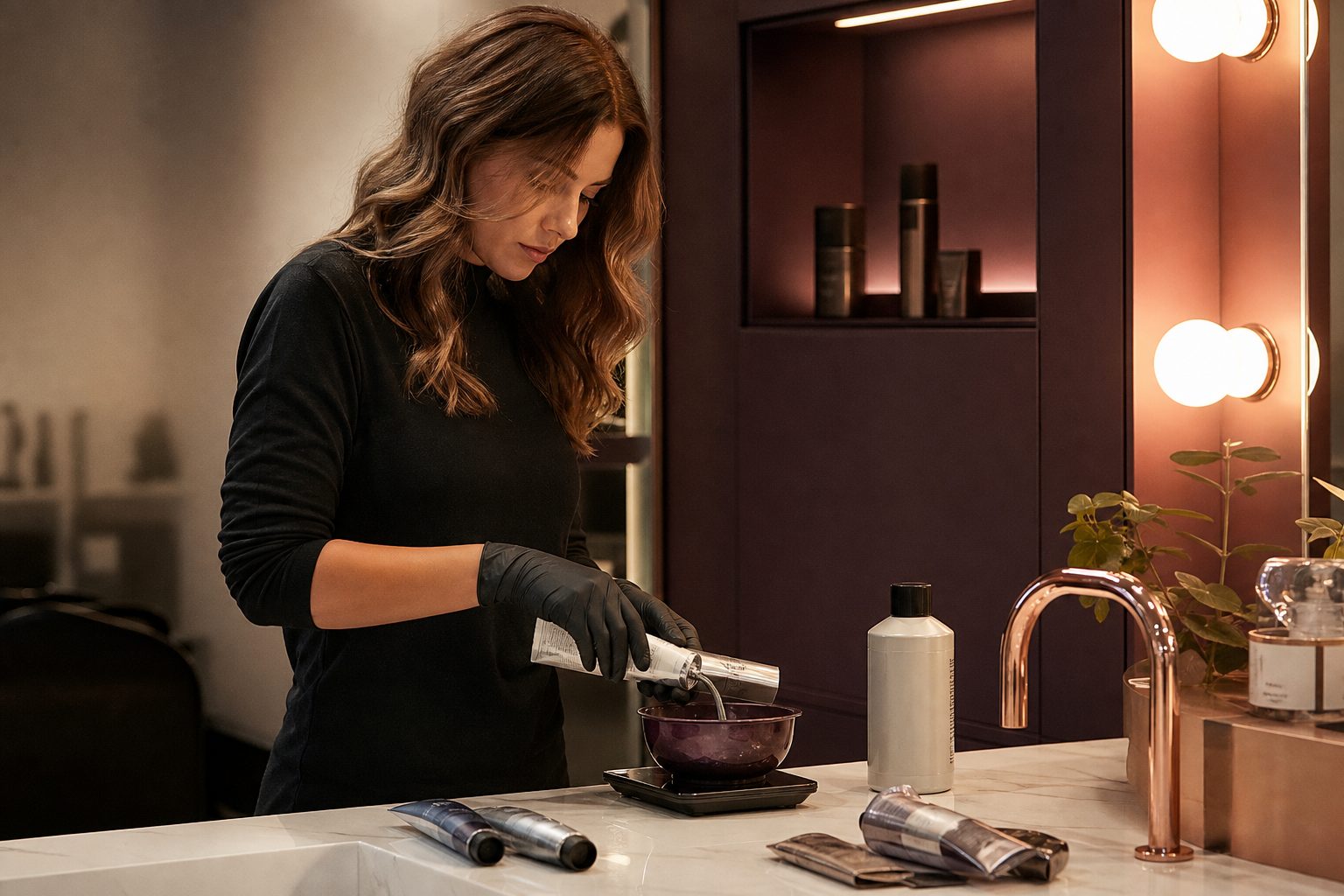
Charging one flat price no matter how many bowls the head takes
Flat pricing for color may seem simple, but it quietly eats up profit on every longer or thicker head of hair. The cost of professional color lines has gone up in recent years, and a single process on a short pixie cut rarely takes the same amount of product as a balayage on mid-back hair. Still, many stylists hesitate to break out the extra bowls, feeling it may come across as nickel-and-diming the guest.
The truth is, flat pricing puts the stylist in a tough spot. As soon as the appointment runs long or the hair demands more product, the margin on that service vanishes. The guest with shoulder-length hair essentially subsidizes the one with a mane down to her waist. This adds up, especially when multiple bowls are mixed for specialty services.
To fix this, start breaking down the service by what it actually takes to get the job done. Build a starting price for the service that covers the average head, then add a clear, fair charge for each extra bowl mixed. Communicate this policy up front so clients are not surprised. Most understand: more hair or a drastic change takes more product and time, and that is reflected in the ticket.
Keep reading: Booth Renter or Employee: The Tests That Decide Your Status
Never costing color and developer by the ounce
Many booth renters and independents estimate color costs by eye or memory, but never actually calculate what a tube, bottle, or scoop costs them per ounce. Without this knowledge, even a well-intentioned price list can leave money on the table. For example, a tube of professional color might run anywhere from eight to fifteen dollars, and developer adds to that outlay. A few extra ounces per client, over dozens of services, quietly erodes margin.
Waste is another issue. If you habitually mix too much and wash the leftovers down the drain, that is money lost. Over time, this adds up to hundreds of dollars in product thrown away each year. For many stylists, the cost of product used is one of the biggest controllable expenses in the business.
The fix is to measure and track color and developer every time you mix. Invest in a simple scale or use the graduations on your mixing bowl. Write down how many ounces you use per client, and do a quick calculation of your average product cost for each service. Over a month, you will spot trends: which services use the most product, which ones generate waste, and where you may need to raise prices or change your mixing habits.
Some stylists go a step further and set up a small menu surcharge for extra product beyond a baseline. This keeps pricing fair for both short and long haired clients, and builds in a safeguard against the rising cost of color lines.
Pricing a root retouch and a full head as the same service
It is common to see "all-over color" or "single process" as a single line item, whether it is a root touch-up or full head application. This makes sense from a simplicity standpoint, but it does not account for the extra work and material a full head requires. A root touch-up might use half the product and take less than half the time of a full color, but both are often priced the same.
Over time, this habit leads to undercharging for longer, more demanding services, while possibly overcharging for quick touch-ups. It also creates confusion for guests who may not know the difference between the two appointments.
The change here is straightforward. Separate root retouch and full head color as distinct services on your menu. Spell out the difference in the description: root retouch covers up to a certain regrowth length, while a full head applies color roots to ends. Set a fair price for each, and review the timing and product usage so you are not shortchanging yourself on the longer service.
When booking, confirm the guest's needs ahead of time. If they are new or have not been in for several months, what they need could be a full color. This helps avoid sticker shock and overlong appointments.
Keep reading: Anatomy of a No-Show Fee Chargeback, Start to Finish
Giving away the toner, the gloss and the blow dry after color
Bundling add-on services for free happens often, especially with toners, glosses, and blow dries after color. Many stylists throw in a toner "just to perfect the shade," or a gloss "for extra shine," and send the guest out with a professional blow dry at no extra charge. Over time, these extras become expected, and the line between the base service and the full package blurs.
The true cost of add-ons
Toner and gloss both involve additional product, time, and expertise. Depending on the brand, a bottle of toner or gloss can cost more than ten dollars, and each application chips away at your average ticket. The blow dry is another cost: it takes time, energy, and sometimes extra styling products. If you are not charging for these, your hourly earnings drop every time you finish a color service.
How to stop giving it away
List each add-on as a separate line item on your menu, with a clear price. During the consultation, explain what the toner or gloss does and let the client choose whether to add it. If the service is truly needed, bundle it into the base package at a price that reflects the extra cost. For blow dries, make it clear which services include one, and which do not. This way, you set expectations and protect your margin.
Once you draw the line between base color and add-ons, you may find clients are happy to pay for the extras that make their color look its best. More importantly, you stop working for free.
Quoting a color correction by the service instead of by the hour
Color corrections are a different animal. No two heads are alike, and the time, product, and skill required can vary wildly. Still, many stylists quote a flat price for a correction based on the last similar job, or a gut feeling. This is risky. One correction may take ninety minutes, another six hours over two appointments, and the cost of color can be substantial.
Flat quotes for corrections tend to backfire. If the process takes longer than expected, the stylist eats the extra time and product. If the correction is simpler, the client may feel they overpaid. This can also lead to uncomfortable conversations in the chair if the job turns out to be trickier than it looked at the start.
The fix is to price corrections by the hour, not by the job. During the consultation, explain that corrections are billed hourly, with a product surcharge if needed. This sets the expectation that complex jobs may cost more, and straightforward ones may cost less. It also frees you to take the time needed to do the job right, without feeling rushed or underpaid.
Make sure to communicate the expected range of hours, and update the guest if the job looks like it will run longer. This transparency builds trust and protects your margin, no matter how the appointment unfolds.
See how ShearHold handles this for beauty and salons
Leaving foil count, extra product and hair length off the ticket
Foil highlights, balayage, and specialty color techniques all vary by head and hair type. Yet, many stylists stick to a flat fee for a "partial" or "full" foil, regardless of how many foils go in or how much product is used. Over time, the guest with thirty foils pays the same as the one with seventy, even though the work and product cost are double.
Hair length and thickness matter too. Someone with dense, waist-length hair will use much more product and take longer to foil than a client with a thin bob. If you do not factor this into the ticket, you lose money on every long or thick head in your book.
How to build in the extras
Start by setting a base price that covers the average amount of foils, product, and hair length. Then, spell out extra charges for additional foils or bowls of color. For example, a full foil might include up to forty foils, with a small charge for every ten foils beyond that. Do the same with product: a surcharge for each extra ounce or bowl mixed.
For hair length, use clear categories: short, medium, long, and extra long. Each should have a defined price difference based on the additional time and product needed. During the consultation and before mixing, confirm which category the guest falls into so there are no surprises at checkout.
This approach makes your pricing transparent and fair, protects your profit, and avoids awkward conversations about why a service cost more than expected.
Raising prices every three years instead of reviewing them annually
Many stylists put off raising prices, waiting until the cost of color, rent, or utilities has risen so much that a big increase feels unavoidable. Three years can go by before a price change hits the menu. By then, inflation and vendor price hikes have chipped away at profit, and the jump required to catch up can feel steep for both the stylist and their clients.
Annual price reviews make increases smaller and easier to explain. They also give you a chance to factor in incremental rises in product and overhead, and to adjust for new services or techniques added to your menu. Sticking with the same price for years leaves you paying more for supplies and earning less per hour, while clients become conditioned to bargain rates.
Set a calendar reminder to review prices once a year. Look at your product costs, rent, utilities, and time spent per service. If your profit per hour has slipped, consider a small increase. Communicate changes to clients with plenty of notice, and explain what has changed if they ask. Most will understand, and you will avoid the need for a major hike down the road.
Keeping your service list up to date also means removing old, rarely requested color techniques and focusing on what you do best. This keeps your menu lean and your pricing in line with your actual costs.
Reviewing pricing regularly is easier when you have a system that tracks product usage, service times, and booking patterns. Tools that capture booking deposits, enforce no-show fees, and enable one-tap rebooking give booth renters and independents control over their schedules and finances, making it simpler to protect their time and margin in a busy salon environment.